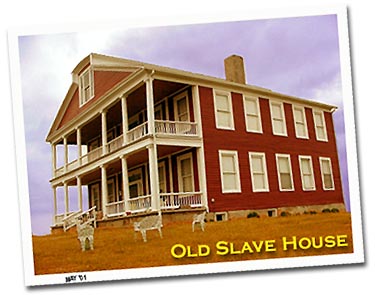
Showing posts with label Old Slave House. Show all posts

Thursday, February 28, 2013

New Faces Lead Historic Preservation Agency

After a few years of little contact with the Illinois Historic Preservation Agency that's changed with the resumption of the Illinois Amistad Commission. There's a number of new faces now.
  • Sara Meek is the new legislative liaison for the agency. She started Feb. 18 and made the news this week as she's the first person to hold that position in the agency which has been fraught with budget cuts over the last decade or so. She has a close relationship with at least one lawmaker, her mother, state Rep. Sue Scherer, D-Decatur. I had a chance to meet with her last month at the first meeting of the new Amistad Commission in Chicago. She offered good first impressions and should help the agency. It's not just funding issues that the agency faces. At some point there will need to be legislative solutions if the agency will still be able to fulfill its missions.

  • Amy Martin is the relatively new director that I also got to meet for the first time at the Amistad Commission meeting. She started last May. She had previously served as acting deputy director of regional outreach for Illinois Main Street in the Department of Commerce and Community Affairs. First impressions: I like the fact she doesn't hesitate to say what she thinks, or at least what she thinks should be said when it comes to her agency. I also like what I've read about the new directions she wants to take the agency. More on that below.

  • Alyson Grady now heads the Historic Sites Division which oversees the Old Slave House among other sites. I have not met her yet but hope to do so soon. There's already been one major change in historic sites that makes sense from both a management and a tourism perspective. Grady announced last month that all five state-owned historic sites in Springfield will be under the management of a single site superintendent. More on that later as well.

  • Kristy Bond started Feb. 11 as the agency's new marketing director. The Abraham Lincoln Presidential Library and Museum used to have a position, but Bond's new job not only covers the museum but the agency's other locations statewide. 
Also in terms of personnel changes, Evelyn Taylor, the agency's long-time Constituent Services Division Manager who oversees the educational programs and publications is retiring. Her last day is today.

The 2012 Annual Report for the agency was her last major project.

In her previous position at the Illinois Main Street program Martin worked with communities to expand local economies at the intersection of economic development and historic preservation. That is an attitude greatly need in IHPA.

(It's not so much that her predecessors were opposed to it, but were more focused on maintaining whatever they could of the agency's core mission and responsibilities. Today the agency has suffered more in proportion to its budget and staffing than any other agency in the state. Martin, it seems, is ready to think outside the box.)

Here's what she told the State Journal-Register when she was hired last year.
"One of the things I hope to continue (at IHPA) is by generating revenue at all of the historic sites – it's important, especially important for us, to bring in that essential funding during these tough economic times," Martin said.

Martin declined to go into specifics about her plans, saying she will confer with her staff and review their accomplishments.

Martin said she applied for the IHPA position because of her Main Street background.

"I am very interested in how historic preservation can be used as an economic development tool," Martin said. "Through my efforts with that program at DCEO, I worked a lot with IHPA staff and historic preservation."

Did you notice that part about "generating revenue" at historic sites. That's been a major roadblock agency. They've not been expected to generate revenue. In fact, the General Assembly whether as individual lawmakers making threatening phone calls, or acting collectively, have actively discouraged the agency for generating revenue through one-time event fees or admission fees.

The historic sites division has gone from 148 to around 67 staff members in the last decade. That figure is a year or so old so it is probably worse now. Many historic sites, if they are still open, are down to just one full-time person. Obviously, the trend can't continue or the agency will be forced to close down additional sites.

Not only is that bad for history, but for local economies that rely on tourism to be a part of their economic mix. It's also bad for efforts to re-open the state's other sites which have been stuck in limbo for years if not decades. We're starting Year 13 of state ownership of the Old Slave House with no plan in site to re-open it. Even worse, it's around Year 67 for the Shawneetown State Bank historic site that remains closed.

That Martin actually recognizes the role her agency plays in economic development represents a major step forward. My biggest disappointment with 1990s-era Brent Manning at the Illinois Department of Conservation was his reluctance, and even denial, that state parks somehow didn't have a role in Illinois tourism.

I had a conversation regarding these themes a few years ago with Justin Blandford who's now tasked with overseeing five state historic sites in Springfield. At the time, he was with the Old State Capitol site, but was also acting as the interim director of the Historic Sites Division at the time. Coming up from a well-visited historic site he understood the issues of lack of coordination between sites and the simple fact that Springfield tourists who come to see Lincoln sites don't care about the administrative make-up of the agencies involved, they just want a coherent, entertaining and educational experiences.

He's explained the current moves at the start of the year to the Springfield paper.

"What we will be moving toward is where we have the flexibility to assign staff among all the sites," said Blandford. "While that seems like a very simple action, that did not happen very much in the past."

He said administrative staff also can be assigned to more front-line duties. "I also see myself doing more at all the sites," said Blandford.

Blandford, who is moving his office from the Old Capitol to the Dana-Thomas House, said the changes should not be noticeable in the day-to-day experience of visitors.

Operating hours remain the same, and a variety of special events, including the “History Comes Alive” living history program, will be scheduled again this year. Each site also will retain its unique look and identity, he said.

"We want to make sure people understand what this is not. This isn’t any quick and fast changes of these sites," said Blandford. "We hope this uplifts the confidence the volunteers, the community members, the business sponsors and the staff have in these sites.

"That's a major component of this: continuing to support morale and to give new confidence that all these sites are solid for what they do for the community, both economically and historically," Blandford said.

The staff cuts aren't so good but the agency appears to be responding in the right direction.

Saturday, December 29, 2012

Video Shows Old Slave House Dig

The Illinois Archeology Survey posted a video earlier this year highlighting three digs from 2011, including the Old Slave House at Equality and the Cahokian complex near East St. Louis where the new interstate bridge will cross the Mississippi River.

The 13:13 minute video shows Illinois archaeologists out in the field.

Sunday, January 16, 2011

This Day in Illinois History - Jan. 16

On this day in Illinois history, Jan. 16, 1862, Col. Edmund D. Taylor supposedly met with Abraham Lincoln in the White House and suggested the use of treasury notes printed on banking paper to be used as legal tender. These notes, as they became known, were the nation's first greenbacks.

I write supposedly because the letter from Abraham Lincoln written in December 1864, confirming this incident has been declared "spurious" by some historians. That it once hung on display in Lincoln's tomb and its whereabouts today unknown doesn't help the matter.

There's a second letter on the 16th that served as a letter of introduction for "Mr. Taylor" to Treasury Secretary Salmon P. Chase. However, it's not clear if this was a reference to Col. Taylor, as Lincoln would have known him, or to another person named Taylor.

The earliest reference I've found comes from a Feb. 24, 1876 issue of the Decatur Local Review. In a series of news briefs on the front page the following references Col. Taylor and the greenback, though the identity of the "professor" is unknown to me at this point.

"The professor is becoming jealous of the greenback popularity of Col. Taylor, and it is said that is the reason why the professor refuses to put up the ticket."

It's very oblique but it does mention Taylor and the currency in the same breath.

Taylor and Lincoln's acquaintance dated back three decades when Lincoln first ran for the legislature following the Black Hawk War. Lincoln lost that election. Taylor won.

Though on opposite sides most of their lives, for one point in the mid 1850s, or at least in 1854, the two became political allies in the fight against Stephan Douglas, then the state's senator. Lincoln was a new Republican and Taylor, an anti-Nebraska Democrat.

I first came across E. D. Taylor in the pages of Springhouse magazine. Gary DeNeal, my fellow "Crenshaw Rascal" in the search for the real story of the Old Slave House came across Col. Taylor who was John Hart Crenshaw's brother-in-law. Taylor also held the mortgage on the Old Slave House for many years.

I didn't realize it at the time, but Taylor was one of my fourth-great uncles (my great-great-great-great uncle). His father, Giles Taylor, was Crenshaw's father-in-law and my fifth-great grandfather.

Taylor played an important role in the development of Chicago as the receiver of public monies at the federal land office. He later got into banking in Indiana, coal mining in La Salle County and real estate development in Chicago.

Although his role in the greenbacks is questioned, his financial acumen is not. Nor was his son-in-law's who served as comptroller of the City of Chicago.

On Nov. 8, 1855, the Alton Weekly Courier reprinted news from Chicago about Taylor's business skills.

Several sales of real estate have been effected within the week of importance. Col. E. D. Taylor sold $68,000 worth of property on cash and short time. Less than seven years since the same property cost the Col. but $8,000. A nice little transaction. But such is not an uncommon occurrence in Chicago.

Taylor, who was born Oct. 18, 1804, at Fairfax Courthouse, Va., died Dec 4, 1891, in Chicago.

Thursday, January 13, 2011

This Day in Illinois History - Jan. 13

'Uncle Bob' Wilson born in 1836

His parents are unknown and despite having fathered supposedly hundreds of children, he died without family at the age of 112.

On this day in Illinois, Jan. 13, in 1836, a slave child named Robert Wilson was born on a plantation near Richmond, Virginia. He would be known in his old age, and remembered long after his death as "Uncle Bob."

For at least the last 25 years of his life he repeated stories that he had been used as a stud slave on seven different plantations, the last of which was the house on top of the hill outside of Equality, Illinois.

Residents knew it then as John Crenshaw's Hickory Hill Plantation. Today it's known as the Old Slave House.

His role of a stud slave probably took place in the 1850s as he was back in Virginia when John Brown was hung on Dec. 2, 1859.

He entered the Civil War on the Confederate side with the 16th Virginia Infantry. An Associated Press article about him from his 111th birthday in 1947 described him as a "batman," which wasn't a Gotham crime-fighter but a term for an orderly or servant to an officer. A United Press wire story after his death the next year described his duties as having "to shine boots for a Confederate officer."

After the war he was a Baptist minister at times. He made it back to Gallatin Co., Illinois by the late 1920s or 1930s. He lived in Equality briefly following the 1937 flood that devastated Shawneetown and moved to Chicago sometime later in the decade.

He eventually made it to Chicago and was transferred to the Elgin State Hospital in 1942 suffering some illness. At the time he was not surprisingly, the oldest inmate in the veterans colony there.

He's smiling in almost all of the photographs I've seen of him. The stories from his time in Elgin show him quick of wit. Once when Gov. Dwight Green visited the institution Wilson hit the politician up for a donation to his tobacco fund. With a posse of reporters and photographers trailing his tour, Green couldn't refuse and gave him a 50-cent piece which he long treasured as his lucky coin. When he lost it, Green sent him another one for his 111th birthday.

Wilson also told the secret to his long life to the staff at Elgin, "I never drank, chewed, or stayed out late until I was 11 years old." Good advice for us all.

Sunday, February 14, 2010

Old Slave House Presentation Monday

I'll be giving a presentation on the Old Slave House tomorrow, Monday, Feb. 15, 2010, at the Marion Carnegie Library in Marion, Illinois. The program starts at 6 p.m.

The library is located on South Market Street two blocks south of the square. The event is free.

Monday, February 18, 2008

Governor Considering Entry Fees for Parks

Lee Enterprise's Kurt Erickson is reporting that Gov. Rod Blagojevich may push entry fees for state parks in Wednesday's budget address.
Although the final touches are still being made to the governor’s latest spending proposal, officials acknowledge they’ve considered imposing entrance fees at state parks as a way to balance the budget in tough financial times.

Details of what those fees might be were not available Monday and it’s not clear whether they would affect users of all of the state’s more than 100 state parks, forests and natural areas, most of which are located in downstate Illinois.

That may not actually be a bad thing, depending on the details.

Our system of state parks and historic sites are in crisis. Staffing levels at the various sites are at the lowest levels in decades. The Historic Sites Division of the Illinois Historic Preservation Agency has lost around 40 percent of its staff in the last six or seven years. A number of sites are simply mothballed and barricaded off from the public.

I understand the desire of keeping free admissions so that everyone can participate regardless of income, but it's becoming increasingly clear that free access equals no access when there's no money.

In Southern Illinois in the counties along the Ohio River there are five IHPA sites and absolutely no state employees.

The Department of Natural Resources faces similar struggles with state parks though not as severe.

Like the current proposals from the U.S. Forest Service for fees on the Shawnee National Forest it's not the overall concept that's worrisome, it will be in the details.

I made this argument a decade ago and have repeated it ever since now through three governors: It's ridiculous to take a site such as the Old Slave House (which was once privately operated with admissions) and keep it closed because there's no money for staffing yet while there's enough interest to draw large crowds that would pay to enter the facility.

The same admission price wouldn't work for all sites. A market driven approach based on interest and operating costs much like California's approach should be used. There it costs much more to visit major sites such as the 115-room Hearst Castle ($20 to $30 for adults depending on the tour and the season) than it does to visit the Gold Rush museum at Sutter's Fort historic site ($4 for adults).

In Illinois there could be one price for Lincoln sites in Springfield, or one ticket for parks and sites in other tightly knit areas.

If the governor moves forward with this it's also time to look at merging the Historic Sites Division of IHPA with the Division of Land Management in DNR as well as the state museums into one site-based agency.

This may be brought about due to budgetary constraints, but there's larger problems out there that could be solved at this time if a big picture approach was taken.

Maybe we'll be surprised Wednesday. I just hope the issues of parks and historic sites will finally be addressed.

Cross posted on the Illinoize politics and public policy blog at over at Capitol Fax and the Williamson County Tourism News blog.

Friday, November 03, 2006

Ballroom Doors Gone at Hickory Hill

I talked with some of the project team at RATIO Architects this morning concerning the Old Slave House. One of the items discussed centered on the old ballroom that once occupied the front half of the second floor of the Old Slave House.

We had hoped that the old folding doors that once separated the front bedrooms and the hallway were still there just enclosed in the walls. Regrettably the team didn't find any doors last week.

However, they did find where the doors connected which might help them be able to reconstruct what they looked like. They didn't find any track in the floor for the doors and will check the top of the open on one of their future trips.

Tuesday, October 31, 2006

A Hidden Floor and a Forgotten Window

The architects and researchers hired by the Illinois Historic Preservation Agency have made some interesting finds in their two working trips down to the Old Slave House.

According to George Sisk the biggest surprises so far have been a second floor in the carriage way and a blocked-up window in the crawl space under the northeast bedroom.

The carriageway is the 19th Century "garage" on the rear side of the house that allowed horse-drawn vehicles halfway into the structure. From the picture you can tell it was as wide as the row of windows that are visible above the modern sliding-glass door.

In Crenshaw's day we have assumed that the "floor" of the carriageway was at ground level and just dirt.

George has long told of a story passed down in his family about his grandfather building the current floor in the family room that is now the former carriage way. His grandmother didn't like having to walk down down a few steps when entering the room and then walk back up in order to go to the room on the other side so his grandfather built the floor up to the same level as the rest of the house.

Apparently though, it was the second floor built across the carriageway. The researchers have discovered an earlier one about a foot or so lower than the rest of the floors on the first level.

While standing in the cellar beneath the northwest room of the house you can look through an opening in the inner foundation wall into the carriageway and can see the bottom of this floor above.

I had assumed it was the bottom of the floor I had walked across in George's family room. Apparently it is not, which from my memory would make sense because I had previously wondered about the lumber holding up the floor as it looked older and larger than typically used in early 20th Century carpentry.

Now the question is just how old is this floating mystery floor?

I don't think it's original. George's grandfather told of a story passed down in the area about how Crenshaw got a kick out of riding one of his horses into the carriageway because the horse liked to look at itself in the mirrors that hung on the walls.

Secondly, in 1942, a daughter of one of John Crenshaw's nieces who lived in the house in the 1840s, recalled the stories of her mother and aunt concerning the carriageway:

The second floor was a grand Ballroom. Mother and Aunt used to tell us about watching the beautifully dressed guests drive into the hall. They never got out of the carriage outside of the house and many do the same in California now.

[Source: Mrs. W. F. Brann. April 22, 1942. Letter to Mrs. A. J. Sisk. George Sisk Collection. Junction, Ill. (since transferred to the Abraham Lincoln Presidential Library in Springfield, Ill.)]

The ballroom in question consisted of the front half of the second floor as the interior walls between the front corner rooms and the front hall contained folding doors much like modern conference rooms.

Though not visible to the thousands of tourists who toured the house when it was open, the indentions of where the doors once stood can still be seen from inside the corner rooms. I don't know if the architects have yet tore into those walls to see if the doors might still be there.

George had actually ran into the second floor when he installed gas heat into living quarters but had forgot it was there. The other intriguing find so far was a surprise even for him.

In the picture above there is a small window at ground level on the far right side of the foundation. This allows light into the cellar under the northwest room.

A second window has been discovered now in the foundation crawl space of the northeast room which would presumably be about the same distance from the carriageway entrance as the window above is, except on far left side of the picture.

This window has been bricked up and covered with the cement stucco visible around the outer foundation wall.

Today, there is a cellar across the front half of the house that is accessable from the outside, and the smaller cellar under the northwest room accessible from the room above inside. As far as we know there has never been a cellar underneath the northeast room.

Assuming that the foundation walls under the northeast side of the house go as deep as the walls on the other sides and now that we know there was a window there, the question is now whether a cellar existed there or not?

If so, why did someone fill it in?

One intriguing possibility comes from a story passed down by a woman who moved into the house in 1851. In 1936, a local county historian interviewed her on behalf of a Springfield historian working with one of Crenshaw's descendants digging into the history of the house.

The elderly woman, whom we believe to be Mary (Leishtenberger) Ulmsnider, told the local historian the following:
One room had blood stain on the wall and the floor had been taken up and earth filled where the floor had been on account of the blood stains

[Myra Eddy Wiederhold. April 2, 1936. Letter to Frank E. Stevens. Charles C. Patton Collection. Springfield, Ill.]

Myra Wiederhold was the Lucille Lawler of Gallatin County in the mid-20th Century. She was the local county historian researchers used. She was the granddaughter of Henry Eddy who also was Crenshaw's attorney, and her sister married a grandson of Gen. Michael K. Lawler who was also a great-grandson of Crenshaw as well.

In her letter she most likely paraphrased what the old woman told her. If she paraphrased it in the order she heard it and if the speaker kept a logical order herself while telling the stories, then the reference to the blood stains likely is pointing to a room on the third floor since the sentences both before and after refer to items on that floor.

However, I've found it rare for people I'm interviewing to necessary keep a logical order when recalling events that happened decades earlier. Mostly it's just flashes and tidbits. If the blood stain reference was just a random thought, or if Myra simply misunderstood her source, then it could refer to a forgotten cellar under the northeast side of the house.

Of course, that leads to the next question of how was the cellar accessed? Was there another staircase from that room going down to it? If so, was there another staircase along the back wall of the northeast room going to the second floor like there is going to the northwest room?

Questions, questions, questions. The more researchers dig into the house, the more we find.

UPDATE! 12:47 pm November 1, 2006

The more I think about the floating floor in the carriageway the more I remember a conversation I've had with a Dempsey descendant sometime over the last few years.

The Dempseys never owned the house, but operated the coal mine at the bottom of Hickory Hill. According to their traditions the family lived in the Old Slave House at two different times, the first time in the early 1890s and again after the turn of the 20th Century.

I think someone once told me that it was their grandfather who had built the floor in the carriageway, but at the time I discarded the info because it didn't fit with what I already thought I knew (a problem that a lot of people have had with the Old Slave House).

As they operated the coal mine below the house that would explain the oversized timbers used to support the floor - they might be the same timbers used in the mine itself.

Just a thought and maybe a hypothesis.

Monday, October 30, 2006

Old Slave House Closed 10 Years Ago


Tuesday is the 10th Anniversary of the closing of the Old Slave House. Former owner George Sisk closed the site on Thursday, Oct. 31, 1996, after 70 years of operation.

This Saturday also marks the 10th Anniversary of Ron Nelson's discovery in the Illinois State Archives of the first solid proof that the stories were real.

I joined the research team of Ron and Gary DeNeal the following day.

Since then we've dug into attics and courthouse vaults in Illinois, Indiana, Kentucky, Tennessee, Missouri, Alabama, Louisiana and Texas, pulling out clues to what really happened in Southern Illinois atop Hickory Hill.

In December 1996, Vincent DeForest of the National Park Service toured the house and told us then, if we could prove the stories, the Old Slave House would make one of the best sites in the entire country to interpret slavery.

Two years ago, the National Park Service looked at part of the research and agreed, adding the Old Slave House to its National Underground Railroad Network to Freedom program in recognition of its kidnapping history as a station on the Reverse Underground Railroad.

Just after that I was able to publish our entire researching findings in a new book about the site, entitled, "Slaves, Salt, Sex & Mr. Crenshaw".

The Illinois Historic Preservation Agency purchased the house in December 2000. They acquired most of the antiques in 2003 and a few more items last year.

Yet the house remains closed.

People ask me all the time if the state plans to reopen the house.

Yes, that's what they intend to do, but no, they don't actually have any plans to do so. Good intentions are free. Plans requiring funding or authorization from above.

Since the Old Slave House closed 10 years ago, two of the three gas stations in Equality Township have closed as well. Tourism efforts by local leaders continue to be thwarted as the house and a number of other state-owned sites remained mothballed.

In the past four years IHPA has lost more than 40 percent of its staff in the Historic Sites Division. Even before they lost the staff they only had one employee in southeastern Illinois despite having five sites (Shawneetown Bank, Old Slave House, Rose Hotel, Buel House and Kinkaid Mounds).

The agency is now working on a historic structures report. Though announced this spring, the architects only started last month.

Progress is being made, but very slowly.

To be added to my notification list for updates on the site send me an e-mail with your contact information.

Wednesday, June 07, 2006

Grant Announced for Old Slave House

The newest round of Illinois Transportation Enhancement Grants have been announced including $400,000 in federal highway funding for the Old Slave House.

The funds are to be used for engineering work and a historic structures report. Added to the $150,000 of state funding already announced for a historic structures report, this will allow the agency to likely conduct archeaological surveys and possibly engineering work on visitor services such as restrooms.

IHPA officials asked me for help on this grant last fall both in gathering letters of support as well as helping find the links to the site and transportation issue. While the main link is the site's recognized status as one of the last, if not the last, station on the Reverse Underground Railroad still standing.

Other links included John Crenshaw's role as a road supervisor for the 19th Century version of Route 13 between Shawneetown and Eldorado, as well as his role as a contractor in the first effort to build a railroad between those two towns in the late 1830s.

Overall, almost $2.9 million in grants are headed to Southern Illinois.

Other projects include the following:

  • Cairo - Confluence Tourist Welcome Center at Fort Defiance (I think this would be in the old Toll House) - $673,000.

  • Chester - Tourist Welcome Center in Segar Park near the Mississippi River bridge. This is something needed with the opening of the World Shooting Sports Center at Sparta later this year - 385,000.

  • Saline County - Engineering work for extension of the Tunnel Hill State Bike Trail from Harrisburg to Eldorado to eventually connect the city-owned bike trails in Harrisburg and Eldorado - $110,000.

  • Metrpolis - Brookport - Engineering work for the proposed George Rogers Clark Discovery Trail between Metropolis and Brookport to follow an old railroad grade between the two towns that also crosses through Fort Massac State Park - $354,000.

  • Mount Vernon - Downtown streetscape improvements - $500,000.

  • Rosiclare - Downtown streetscape improvements - $50,000.

  • West Frankfort - Downtown streetscape improvements - $427,000.

Friday, February 03, 2006

Bidding Begins for Old Slave House work

The state is moving forward with the Old Slave House project announced last week.

The Capital Development Board, which oversees state construction projects, advertised for yesterday. The Professional Services Bulletin provides the details:

The scope of work provides for planning and beginning the renovation of the Crenshaw House, including a Historic Structures Report which will provide a description and prioritization of the restoration work to be done. The initial work will focus on making the building weather-tight. This may include roof replacement/repair, restoring windows, siding, flashings and weather seals. The scope of work also provides for the abatement of asbestos containing materials and lead.

The selected firm will be notified of the time and place for the orientation meeting by the contract executive or the project manager. The meeting shall be attended by the firm’s project manager, consultants and a person authorized to make scheduling and financial commitments for the firm.


Finally, it's clear just how much the $150,000 project will cover. Not only do we get the historic structures report, but also the basic repairs hinted at during the news conference.

What's left for future projects will be construction of any visitor services facilities (i.e. bathrooms and the such) as well as the big project of restoration, which could come down the road even after a site is opened.

From another source I found out that there is some discussion of IHPA trying to get at least one staffer to split time between the various IHPA sites in southeastern Illinois.

The good news still is the project is real and moving forward. Bids are due in two weeks on Feb. 16 and the agency will meet to select the winner at their April meeting.

Tuesday, January 24, 2006

Old Slave House Funding Update

Jim Muir's story in today's Southern Illinoisan has literally generated interest around the world for the Old Slave House after UPI sent out a story a little over four hours ago. It's already on the websites of the Washington Times, Science Daily and, my favorite so far, Monsters and Critics.com, a site based in Glasgow, Scotland.

[UPDATE: It's now reached India at the WebIndia123.com site.]

The good news for me is that both Jim and UPI mention the name of my book, Slaves, Salt, Sex & Mr. Crenshaw.

The bad news is that UPI misread Jim's story and has incorrectly labled the house as a station on the Underground Railroad....

[PHONE RINGS. Intrepid blogger picks up phone.]

UPI is sending out a correction. Just got off the phone with them.

[UPDATE: Here's the corrected version.]

Next issue. Is the governor coming down or not?

Last week I was told he wasn't part of the delegation, but Jim had it in the story that he is. However an earlier phone call from a tourism official who was trying to find out about tomorrow's event had been told that he couldn't. The latest news release from the state doesn't mention him and the journalist I talked with doubted he would come back since he toured the region yesterday.

[In Jim's defense, he was working on the story last week for the Saturday or Sunday edition. That may have been the current plan as of last week.]

The most interesting thing about the article was the reference to the site actually reopening.

Rep. Brandon Phelps, D-Norris City, announced last week the state will appropriate $150,000 in funding to renovate the facility that was built more than 170 years ago and has been vacant for nearly a decade.

Phelps said the funding will be used for a twofold purpose.

"We have secured the $150,000 to help renovate the Old Slave House and to also help get it up and running," Phelps said.


Later on he hinted when it could reopen.

Phelps said he expects the Old Slave House to be "up and running" by the end of this calendar year.


As I noted last week, I'm still not sure where the money is coming from. I rechecked my notes from December when I called on the status for possible funding. At that time I was told the money is coming from previously-appropriated unspent allocated funds.

Because of the amount involved I thought it was the capital money Phelps had been working on with the governor last spring. This suggests old money that was still in the hopper. Just how old no one can tell me.

Better yet, it's looking like the money is coming from the General Revenue fund which would allow the governor to not only use the funding for capital projects like any renovations, but also for staffing, a necessity if they want to open before the end of the year.