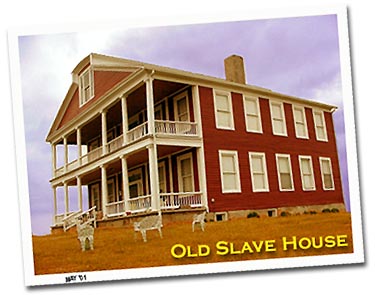
The architects and researchers hired by the Illinois Historic Preservation Agency have made some interesting finds in their two working trips down to the Old Slave House.
According to George Sisk the biggest surprises so far have been a second floor in the carriage way and a blocked-up window in the crawl space under the northeast bedroom.
The carriageway is the 19th Century "garage" on the rear side of the house that allowed horse-drawn vehicles halfway into the structure. From the picture you can tell it was as wide as the row of windows that are visible above the modern sliding-glass door.
In Crenshaw's day we have assumed that the "floor" of the carriageway was at ground level and just dirt.
George has long told of a story passed down in his family about his grandfather building the current floor in the family room that is now the former carriage way. His grandmother didn't like having to walk down down a few steps when entering the room and then walk back up in order to go to the room on the other side so his grandfather built the floor up to the same level as the rest of the house.
Apparently though, it was the second floor built across the carriageway. The researchers have discovered an earlier one about a foot or so lower than the rest of the floors on the first level.
While standing in the cellar beneath the northwest room of the house you can look through an opening in the inner foundation wall into the carriageway and can see the bottom of this floor above.
I had assumed it was the bottom of the floor I had walked across in George's family room. Apparently it is not, which from my memory would make sense because I had previously wondered about the lumber holding up the floor as it looked older and larger than typically used in early 20th Century carpentry.
Now the question is just how old is this floating mystery floor?
I don't think it's original. George's grandfather told of a story passed down in the area about how Crenshaw got a kick out of riding one of his horses into the carriageway because the horse liked to look at itself in the mirrors that hung on the walls.
Secondly, in 1942, a daughter of one of John Crenshaw's nieces who lived in the house in the 1840s, recalled the stories of her mother and aunt concerning the carriageway:
The second floor was a grand Ballroom. Mother and Aunt used to tell us about watching the beautifully dressed guests drive into the hall. They never got out of the carriage outside of the house and many do the same in California now.
[Source: Mrs. W. F. Brann. April 22, 1942. Letter to Mrs. A. J. Sisk. George Sisk Collection. Junction, Ill. (since transferred to the Abraham Lincoln Presidential Library in Springfield, Ill.)]
The ballroom in question consisted of the front half of the second floor as the interior walls between the front corner rooms and the front hall contained folding doors much like modern conference rooms.
Though not visible to the thousands of tourists who toured the house when it was open, the indentions of where the doors once stood can still be seen from inside the corner rooms. I don't know if the architects have yet tore into those walls to see if the doors might still be there.
George had actually ran into the second floor when he installed gas heat into living quarters but had forgot it was there. The other intriguing find so far was a surprise even for him.
In the picture above there is a small window at ground level on the far right side of the foundation. This allows light into the cellar under the northwest room.
A second window has been discovered now in the foundation crawl space of the northeast room which would presumably be about the same distance from the carriageway entrance as the window above is, except on far left side of the picture.
This window has been bricked up and covered with the cement stucco visible around the outer foundation wall.
Today, there is a cellar across the front half of the house that is accessable from the outside, and the smaller cellar under the northwest room accessible from the room above inside. As far as we know there has never been a cellar underneath the northeast room.
Assuming that the foundation walls under the northeast side of the house go as deep as the walls on the other sides and now that we know there was a window there, the question is now whether a cellar existed there or not?
If so, why did someone fill it in?
One intriguing possibility comes from a story passed down by a woman who moved into the house in 1851. In 1936, a local county historian interviewed her on behalf of a Springfield historian working with one of Crenshaw's descendants digging into the history of the house.
The elderly woman, whom we believe to be Mary (Leishtenberger) Ulmsnider, told the local historian the following:
One room had blood stain on the wall and the floor had been taken up and earth filled where the floor had been on account of the blood stains
[Myra Eddy Wiederhold. April 2, 1936. Letter to Frank E. Stevens. Charles C. Patton Collection. Springfield, Ill.]
Myra Wiederhold was the Lucille Lawler of Gallatin County in the mid-20th Century. She was the local county historian researchers used. She was the granddaughter of Henry Eddy who also was Crenshaw's attorney, and her sister married a grandson of Gen. Michael K. Lawler who was also a great-grandson of Crenshaw as well.
In her letter she most likely paraphrased what the old woman told her. If she paraphrased it in the order she heard it and if the speaker kept a logical order herself while telling the stories, then the reference to the blood stains likely is pointing to a room on the third floor since the sentences both before and after refer to items on that floor.
However, I've found it rare for people I'm interviewing to necessary keep a logical order when recalling events that happened decades earlier. Mostly it's just flashes and tidbits. If the blood stain reference was just a random thought, or if Myra simply misunderstood her source, then it could refer to a forgotten cellar under the northeast side of the house.
Of course, that leads to the next question of how was the cellar accessed? Was there another staircase from that room going down to it? If so, was there another staircase along the back wall of the northeast room going to the second floor like there is going to the northwest room?
Questions, questions, questions. The more researchers dig into the house, the more we find.
UPDATE! 12:47 pm November 1, 2006
The more I think about the floating floor in the carriageway the more I remember a conversation I've had with a Dempsey descendant sometime over the last few years.
The Dempseys never owned the house, but operated the coal mine at the bottom of Hickory Hill. According to their traditions the family lived in the Old Slave House at two different times, the first time in the early 1890s and again after the turn of the 20th Century.
I think someone once told me that it was their grandfather who had built the floor in the carriageway, but at the time I discarded the info because it didn't fit with what I already thought I knew (a problem that a lot of people have had with the Old Slave House).
As they operated the coal mine below the house that would explain the oversized timbers used to support the floor - they might be the same timbers used in the mine itself.
Just a thought and maybe a hypothesis.
 I was in a recliner this morning at writing down some ideas for a screenplay when I felt the chair underneath me begin to move. Ironically I had just started a scene with the word "rumbling" to indicate the start of a roof fall in an underground coal mine.