Wednesday, March 18, 2009

Is the End Near for IHPA?

Illinois Governor Pat Quinn announce plans to merge the Illinois Historic Preservation Agency into the Department of Natural Resources during his first budget address to lawmakers.

The move isn't surprising. I told a staffer in the then-Lt. Governor's office that I didn't expect IHPA to survive intact. The agency's Historic Sites Division has lost 60 percent of their staffing since 2000. Even if Quinn restores the cuts made by Gov. Blagojevich last fall, that means there's a 40 percent cut in staff.

While many people feel state government is bloated, I can assure you that IHPA is not the agency where you are going to find a lot of fat. That's been trimmed along with a lot of muscle.

Even with a restoration of recent cutbacks which would reopen the French Colonial sites in Randolph County there's still seven IHPA-owned sites in southeastern Illinois from Lawrenceville down to Golconda that don't have any staff.

Even if all of the late Ryan-era retirements and the Blagojevich-era cuts were restored, there would be just one state employee for those seven sites.

IHPA's heyday occurred during the Thompson Administration when it was spun off from state parks in the Department of Conservation. During the 1990-91 recession Jim Edgar had to slash state spending and IHPA took hits from which to this day they have never recovered.

Historic sites are forgotten assets that need to remembered. I don't see Quinn's move as good or bad for the agency, just expected. What comes next is what will really be important.

Labels: ,

Wednesday, July 09, 2008

Mission Trip Time

It's time again for Second Baptist Church's mission trip to Ukraine. If you want to follow our journey check out the mission trip blog at ukrainemissiontrips.blogspot.com.

Labels:

Monday, April 21, 2008

Region Still Rumbling with Minor Aftershocks

We're on our 18th aftershock since Friday's morning 5.2 magnitude earthquake up near Mount Carmel, Illinois.

I was in a recliner this morning at writing down some ideas for a screenplay when I felt the chair underneath me begin to move. Ironically I had just started a scene with the word "rumbling" to indicate the start of a roof fall in an underground coal mine.

The U.S. Geological Survey's website isn't the easiest to navigate, but here's the page that lists all of the
Check out this aftershocks as well as Friday's earthquake.

Labels:

Friday, April 18, 2008

80th Anniversary of Birger Hanging Saturday

Tomorrow, April 19, is the 80th anniversary of hanging of Charlie Birger, Southern Illinois' most famed gangster.

He was the last man executed by hanging in Illinois and by all accounts most deservedly so. Officially he was sentenced to death for his role in the conspiracy to murder Joe Adams, mayor of West City, Illinois, but was responsible for a number of other deaths, including that of Lory Price, the first Illinois State Policeman to die in the line of duty.

I grew up hearing the family stories about Birger and his hideout, Shady Rest. My grandmother's family, the Angels, lived less than a half mile away from the site to the northwest.

There were stories of gangsters passing counterfeit money in my great-grandparents' store, of Birger offering my grandmother and another friend a ride into Crab Orchard, the offer of medical help for my grandmother's baby sister, and the plaster dog my grandmother and her future husband won at the grand opening of the barbecue stand Birger had established right along the hard road between Marion and Harrisburg.

It wasn't until junior high did I learn about Paul Angle's book, "Bloody Williamson" and Donald Bain's "War in Illinois" since republished as "Charlie and the Shawneetown Dame".

None of the books included my family's stories, but they proved to me there was something real to them.

There was a cheesy western song written after the hanging. Southern Illinois' "original, caustic acoustic band", The Woodbox Gang, has resurrected it and made it sound cool. Here's the video from their performance last fall at the Kennedy Center in Washington, D.C.

Labels: ,

Tuesday, February 26, 2008

The 'King' and 'Little Egypt'

Josie Brooks, owner of the Book Emporium in Harrisburg, recently auctioned off on eBay a 12-year-old American Weekend section of the Daily Register that contained my cover story on how Southern Illinois became known as Egypt.

I saw the sale, bid on it and as I was just notified, lost. I didn't really need it but I haven't been able to find my copy the last time I looked. It really doesn't matter because the original article is posted here.

An expanded version of the story is posted on the wall in the basement of the SIU Student Center near the craft shop as part of a larger display on Southern Illinois and the Egypt theme.

The item on eBay led to a night of Internet surfing searching for Little Egypt references. Here's my favorite and it's also why Will Griffith, the late publsiher of the Egyptian Key magazine back in the 1940s disliked the name "Little Egypt" rather than just "Egypt".


Note: I realize that the Coasters released this song in 1961 and Elvis did it in 1964 in the movie "Roustabout", long after Griffith died, but Little Egypt the dancer had been around in one form or another since 1893. There was even a movie about the dancer titled "Little Egypt" in 1951.

For more on the dancers named Little Egypt, check out the Wikipedia article. It seems fairly accurate.

In the whole debate over Little Egypt versus Egypt, I prefer Egypt as the historical name for Southern Illinois, but Greater Egypt for modern usage.

Labels:

Monday, February 18, 2008

Governor Considering Entry Fees for Parks

Lee Enterprise's Kurt Erickson is reporting that Gov. Rod Blagojevich may push entry fees for state parks in Wednesday's budget address.
Although the final touches are still being made to the governor’s latest spending proposal, officials acknowledge they’ve considered imposing entrance fees at state parks as a way to balance the budget in tough financial times.

Details of what those fees might be were not available Monday and it’s not clear whether they would affect users of all of the state’s more than 100 state parks, forests and natural areas, most of which are located in downstate Illinois.

That may not actually be a bad thing, depending on the details.

Our system of state parks and historic sites are in crisis. Staffing levels at the various sites are at the lowest levels in decades. The Historic Sites Division of the Illinois Historic Preservation Agency has lost around 40 percent of its staff in the last six or seven years. A number of sites are simply mothballed and barricaded off from the public.

I understand the desire of keeping free admissions so that everyone can participate regardless of income, but it's becoming increasingly clear that free access equals no access when there's no money.

In Southern Illinois in the counties along the Ohio River there are five IHPA sites and absolutely no state employees.

The Department of Natural Resources faces similar struggles with state parks though not as severe.

Like the current proposals from the U.S. Forest Service for fees on the Shawnee National Forest it's not the overall concept that's worrisome, it will be in the details.

I made this argument a decade ago and have repeated it ever since now through three governors: It's ridiculous to take a site such as the Old Slave House (which was once privately operated with admissions) and keep it closed because there's no money for staffing yet while there's enough interest to draw large crowds that would pay to enter the facility.

The same admission price wouldn't work for all sites. A market driven approach based on interest and operating costs much like California's approach should be used. There it costs much more to visit major sites such as the 115-room Hearst Castle ($20 to $30 for adults depending on the tour and the season) than it does to visit the Gold Rush museum at Sutter's Fort historic site ($4 for adults).

In Illinois there could be one price for Lincoln sites in Springfield, or one ticket for parks and sites in other tightly knit areas.

If the governor moves forward with this it's also time to look at merging the Historic Sites Division of IHPA with the Division of Land Management in DNR as well as the state museums into one site-based agency.

This may be brought about due to budgetary constraints, but there's larger problems out there that could be solved at this time if a big picture approach was taken.

Maybe we'll be surprised Wednesday. I just hope the issues of parks and historic sites will finally be addressed.

Cross posted on the Illinoize politics and public policy blog at over at Capitol Fax and the Williamson County Tourism News blog.

Labels: , ,

Monday, December 17, 2007

Neat Book on Abraham's Children


OK, it's not Illinois history, but books like this one fascinate me.

Buy the book now online at Amazon.com.

Labels: ,

Sunday, October 07, 2007

Southern Illinoisans Recall World War II in Region

Carbondale writer Lucinda Guinnin has two new features up at AssociatedContent.com focusing on residents' memories of World War II on the Home Front.

The first is Single Mother Worked at Munitions Plant which deals with a single mom working at the Illinois Ordinance plant in what was known as the Ordill in what's now Crab Orchard National Wildlife Refuge outside Marion.

The second story focuses on a young couple from Herrin married in 1942 as they recall the war in Herrin Couple Recalls the War.

Labels:

Friday, December 08, 2006

First Female U.N. Ambassador Dies

The Associated Press is reporting that former U.N. Ambassador Jeane Jordan Kirkpatrick has died. President Ronald Reagan appointed her as the first female American ambassador to the United Nations.

Though a native of Oklahoma, Kirkpatrick grew up in Southern Illinois in Fayette County and attended high school at Mount Vernon Township High School.

I had a chance to meet and speak with the former ambassador in 1985 or 86 when she returned to MVTHS as the keynote speaker for the Mount Vernon Conference, and I was a junior or senior. I later met her a second time at Georgetown University where she was on the faculty when I visited the school my senior year.

She was a true Reagan Democrat, who stayed the course when her party drifted away from confronting tyranny. Like an American version of Margaret Thatcher, she was impressive to watch in the news coverage of the early 80s and equally impressive in person later.

History will remember her well.

Jeane Jordan Kirkpatrick, rest in peace.

Update: Thanks to Power Line Blog for pointing out that Commentary has posted Kirkpatrick's piece, "Dictatorships and Double Standards" which helped lead Reagan to pick her as the face of America at the U.N.

Labels:

Monday, November 13, 2006

Female Civil War Soldier's House to be Restored

Today's Quad-Cities Times outlines work ready to progress at restoring the home of Jennie Hodgers who served in the Civil War and lived most of her adult life under the name of Pvt. Albert D.J. Cashier.
The one-room house is small and unprepossessing. With its shuttered windows and the multiple padlocks that used to be inside its door, it's secretive, too _ much like the person who lived in it for some 40 years.

Now, to honor one of Illinois' most unusual Civil War veterans, plans are being made to move the 130-year-old Albert Cashier/Jennie Hodgers house back to its original site in the Livingston County village of Saunemin from a storage site in nearby Pontiac.

The house's secret was that Cashier and Hodgers were the same person.

Saunemin Mayor Mike Stoecklin told the reporter the house will be back in his city by the end of the year, but restoration will likely take longer.
He said a lecture by former Pontiac tourism director Betty Estes convinced him the house should be restored to its original site. Estes personally stepped in to save the house 10 years ago when Saunemin volunteer firefighters wanted to burn the house as a training exercise; she had it dismantled and trucked to Pontiac for safekeeping.

Way to go Betty, and thank you Mayor Mike for your work to preserve history and help figure out a way today's society can find value in it.

Labels: ,

Blogger Angst Over Lincoln 200 Plans

Marathan Pundit, a/k/a John Ruberry, uses historian John J. Miller's comments in the latest National Review to highlight what both men see as problems in the planning for the bicentennial of Abraham Lincoln's birth in 2009.

As they pointed out, the first events are scheduled for little more than a year away in February 2008. They point to the makeup of the commission leadership as the key issue.

Wednesday, November 08, 2006

Sangamo Frontier Book Looks Good

Robert Mazrim's new book, The Sangamo Frontier: History & Archaeology in the Shadow of Illinois" looks interesting.

I've got a mini-review up for it at the Illinois Writers blog.

Although the publisher sent me two review copies I actually purchased the book last week in part because it might offer a hint of what archaeologists might find next year at the Old Slave House.

The book's title refers to Sangamo Town, which like New Salem, developed and died out within a generation in west-central Illinois in the area of the Sangamon River.

Friday, November 03, 2006

Ballroom Doors Gone at Hickory Hill

I talked with some of the project team at RATIO Architects this morning concerning the Old Slave House. One of the items discussed centered on the old ballroom that once occupied the front half of the second floor of the Old Slave House.

We had hoped that the old folding doors that once separated the front bedrooms and the hallway were still there just enclosed in the walls. Regrettably the team didn't find any doors last week.

However, they did find where the doors connected which might help them be able to reconstruct what they looked like. They didn't find any track in the floor for the doors and will check the top of the open on one of their future trips.

Labels:

Thursday, November 02, 2006

Crenshaw Rascal Ron Does It Again

Tuesday night before I talked with George Sisk about what had happened 10 years earlier on that date, I talked with my fellow Crenshaw Rascal Ron Nelson.

Ron was the one who started the research into the Old Slave House in September 1996 and found the first solid proof that the stories were real on November 4, 1996, up at the Illinois State Archives.

While we talked Tuesday about all that has happened in the last decade he told me about his new research project.

While I won't reveal what it is, it's definitely breaking new ground in what we know about a major social and political character from Illinois history who lived here in the 1820s and early 1830s.

As a preacher and a former resident of Hardin Co., Illinois, where he helped organize the county historical society, Ron's interests usually fall into one of two categories. It's either religious history, usually that of the early Baptists, or outlaws and counterfeiters, of which Hardin County had plenty in its early days.

I won't give any more details about his current project other than to say this new project surprisingly may fall into both categories.

Iles House & Museum of Springfield History

I just ran across Will Howarth's blog for the Iles House, the oldest residence in Springfield, Illinois.

It's been moved and renovated to house the new Museum of Springfield History — you know, all of the other history of our state capital that doesn't deal directly with Abraham Lincoln.

It's location at 7th and Cook places it on the edge of downtown and within walking distance of the various Lincoln sites.

Howarth's blog has some great pictures of the work being done as well as some older photographs from when the moved the house to its current location.

Tuesday, October 31, 2006

A Hidden Floor and a Forgotten Window

The architects and researchers hired by the Illinois Historic Preservation Agency have made some interesting finds in their two working trips down to the Old Slave House.

According to George Sisk the biggest surprises so far have been a second floor in the carriage way and a blocked-up window in the crawl space under the northeast bedroom.

The carriageway is the 19th Century "garage" on the rear side of the house that allowed horse-drawn vehicles halfway into the structure. From the picture you can tell it was as wide as the row of windows that are visible above the modern sliding-glass door.

In Crenshaw's day we have assumed that the "floor" of the carriageway was at ground level and just dirt.

George has long told of a story passed down in his family about his grandfather building the current floor in the family room that is now the former carriage way. His grandmother didn't like having to walk down down a few steps when entering the room and then walk back up in order to go to the room on the other side so his grandfather built the floor up to the same level as the rest of the house.

Apparently though, it was the second floor built across the carriageway. The researchers have discovered an earlier one about a foot or so lower than the rest of the floors on the first level.

While standing in the cellar beneath the northwest room of the house you can look through an opening in the inner foundation wall into the carriageway and can see the bottom of this floor above.

I had assumed it was the bottom of the floor I had walked across in George's family room. Apparently it is not, which from my memory would make sense because I had previously wondered about the lumber holding up the floor as it looked older and larger than typically used in early 20th Century carpentry.

Now the question is just how old is this floating mystery floor?

I don't think it's original. George's grandfather told of a story passed down in the area about how Crenshaw got a kick out of riding one of his horses into the carriageway because the horse liked to look at itself in the mirrors that hung on the walls.

Secondly, in 1942, a daughter of one of John Crenshaw's nieces who lived in the house in the 1840s, recalled the stories of her mother and aunt concerning the carriageway:

The second floor was a grand Ballroom. Mother and Aunt used to tell us about watching the beautifully dressed guests drive into the hall. They never got out of the carriage outside of the house and many do the same in California now.

[Source: Mrs. W. F. Brann. April 22, 1942. Letter to Mrs. A. J. Sisk. George Sisk Collection. Junction, Ill. (since transferred to the Abraham Lincoln Presidential Library in Springfield, Ill.)]

The ballroom in question consisted of the front half of the second floor as the interior walls between the front corner rooms and the front hall contained folding doors much like modern conference rooms.

Though not visible to the thousands of tourists who toured the house when it was open, the indentions of where the doors once stood can still be seen from inside the corner rooms. I don't know if the architects have yet tore into those walls to see if the doors might still be there.

George had actually ran into the second floor when he installed gas heat into living quarters but had forgot it was there. The other intriguing find so far was a surprise even for him.

In the picture above there is a small window at ground level on the far right side of the foundation. This allows light into the cellar under the northwest room.

A second window has been discovered now in the foundation crawl space of the northeast room which would presumably be about the same distance from the carriageway entrance as the window above is, except on far left side of the picture.

This window has been bricked up and covered with the cement stucco visible around the outer foundation wall.

Today, there is a cellar across the front half of the house that is accessable from the outside, and the smaller cellar under the northwest room accessible from the room above inside. As far as we know there has never been a cellar underneath the northeast room.

Assuming that the foundation walls under the northeast side of the house go as deep as the walls on the other sides and now that we know there was a window there, the question is now whether a cellar existed there or not?

If so, why did someone fill it in?

One intriguing possibility comes from a story passed down by a woman who moved into the house in 1851. In 1936, a local county historian interviewed her on behalf of a Springfield historian working with one of Crenshaw's descendants digging into the history of the house.

The elderly woman, whom we believe to be Mary (Leishtenberger) Ulmsnider, told the local historian the following:
One room had blood stain on the wall and the floor had been taken up and earth filled where the floor had been on account of the blood stains

[Myra Eddy Wiederhold. April 2, 1936. Letter to Frank E. Stevens. Charles C. Patton Collection. Springfield, Ill.]

Myra Wiederhold was the Lucille Lawler of Gallatin County in the mid-20th Century. She was the local county historian researchers used. She was the granddaughter of Henry Eddy who also was Crenshaw's attorney, and her sister married a grandson of Gen. Michael K. Lawler who was also a great-grandson of Crenshaw as well.

In her letter she most likely paraphrased what the old woman told her. If she paraphrased it in the order she heard it and if the speaker kept a logical order herself while telling the stories, then the reference to the blood stains likely is pointing to a room on the third floor since the sentences both before and after refer to items on that floor.

However, I've found it rare for people I'm interviewing to necessary keep a logical order when recalling events that happened decades earlier. Mostly it's just flashes and tidbits. If the blood stain reference was just a random thought, or if Myra simply misunderstood her source, then it could refer to a forgotten cellar under the northeast side of the house.

Of course, that leads to the next question of how was the cellar accessed? Was there another staircase from that room going down to it? If so, was there another staircase along the back wall of the northeast room going to the second floor like there is going to the northwest room?

Questions, questions, questions. The more researchers dig into the house, the more we find.

UPDATE! 12:47 pm November 1, 2006

The more I think about the floating floor in the carriageway the more I remember a conversation I've had with a Dempsey descendant sometime over the last few years.

The Dempseys never owned the house, but operated the coal mine at the bottom of Hickory Hill. According to their traditions the family lived in the Old Slave House at two different times, the first time in the early 1890s and again after the turn of the 20th Century.

I think someone once told me that it was their grandfather who had built the floor in the carriageway, but at the time I discarded the info because it didn't fit with what I already thought I knew (a problem that a lot of people have had with the Old Slave House).

As they operated the coal mine below the house that would explain the oversized timbers used to support the floor - they might be the same timbers used in the mine itself.

Just a thought and maybe a hypothesis.

Labels:

Monday, October 30, 2006

Old Slave House Closed 10 Years Ago


Tuesday is the 10th Anniversary of the closing of the Old Slave House. Former owner George Sisk closed the site on Thursday, Oct. 31, 1996, after 70 years of operation.

This Saturday also marks the 10th Anniversary of Ron Nelson's discovery in the Illinois State Archives of the first solid proof that the stories were real.

I joined the research team of Ron and Gary DeNeal the following day.

Since then we've dug into attics and courthouse vaults in Illinois, Indiana, Kentucky, Tennessee, Missouri, Alabama, Louisiana and Texas, pulling out clues to what really happened in Southern Illinois atop Hickory Hill.

In December 1996, Vincent DeForest of the National Park Service toured the house and told us then, if we could prove the stories, the Old Slave House would make one of the best sites in the entire country to interpret slavery.

Two years ago, the National Park Service looked at part of the research and agreed, adding the Old Slave House to its National Underground Railroad Network to Freedom program in recognition of its kidnapping history as a station on the Reverse Underground Railroad.

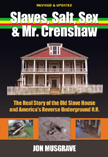
Just after that I was able to publish our entire researching findings in a new book about the site, entitled, "Slaves, Salt, Sex & Mr. Crenshaw".

The Illinois Historic Preservation Agency purchased the house in December 2000. They acquired most of the antiques in 2003 and a few more items last year.

Yet the house remains closed.

People ask me all the time if the state plans to reopen the house.

Yes, that's what they intend to do, but no, they don't actually have any plans to do so. Good intentions are free. Plans requiring funding or authorization from above.

Since the Old Slave House closed 10 years ago, two of the three gas stations in Equality Township have closed as well. Tourism efforts by local leaders continue to be thwarted as the house and a number of other state-owned sites remained mothballed.

In the past four years IHPA has lost more than 40 percent of its staff in the Historic Sites Division. Even before they lost the staff they only had one employee in southeastern Illinois despite having five sites (Shawneetown Bank, Old Slave House, Rose Hotel, Buel House and Kinkaid Mounds).

The agency is now working on a historic structures report. Though announced this spring, the architects only started last month.

Progress is being made, but very slowly.

To be added to my notification list for updates on the site send me an e-mail with your contact information.

Labels:

Friday, October 20, 2006

Preserving the Past Brick By Brick

Kudos to the Harrisburg City Council for considering a plan to save the city's remaining brick streets. Here's what The Daily Register said about it yesterday.
The proposed ordinance requires a permit before any work is done on a city brick street and the firm working on the street must carry a $1 million bond.

The street and alley commissioner is given the authority to issue rules for any excavation on a brick street and a “brick excavation license” is required.

The ordinance says the city will provide classes for contractors in the proper techniques for excavation of brick streets.

A "Brick Street Committee" of three to seven citizens would be appointed to handle affairs involving the future of the city’s brick streets.

The ordinance was developed by the city-appointed brick street study committee and the ordinance proposal was given council earlier this month by Dr. Ray Cummiskey, a member of the committee.
Don't know yet if it passed last night, but I'll along what I learn.

4th Annual Illinois Writers Fair

The Southern Illinois Artisans Shop up at Rend Lake is hosting the 4th Annual Illinois Writers Fair and booksigning Saturday from 9 a.m. to 5 p.m.

I'll be there with all my books. Come on up and enjoy the art.

Bring your checkbook or credit cards, there will be a lot of good books you'll want to buy.

Take Exit 77 on Interstate 57 and following the signs.

Tuesday, October 10, 2006

Saline Creek Village Inhabited By Ghosts?

The paranormal researchers who spent two nights at the Saline Creek Pioneer Village and Museum may have hit the jackpot in their search for evidence.

Saline County Historical Society President Eric Gregg spent two sleepless nights with the group from Tennessee this past weekend. I talked with him Sunday and he was stoked.

Brian DeNeal has the official story in today's Daily Register, so here it is in part:
Members of Southern Paranormal Experiences and Research have hours of audio and videotape to sort out, but they had enough strange pictures early Sunday morning they are eager to pour through the other data.

"One resembles a girl kneeling in the graveyard. We were all pretty impressed with that," SPEAR member Sandy Tullock said.

Thursday, October 05, 2006

Beard Tagged to Run Lincoln Museum

Gov. Rod Blagojevich named Rick Beard as the new executive director of the Abraham Lincoln Presidential Library and Museum complex in Springfield.

Beard has helped run some of the country's biggest museums and is leading the effort to commemorate the upcoming sesquicentennial of the Civil War in 2011 to 2016.

Read more about the appointment in the state news release.

French and Indian War Assemblage Saturday

From the Illinois Historic Preservation Agency:
PRAIRIE DU ROCHER, IL – One of the most historically correct re-enactments of an often little-known conflict will be held during the annual French and Indian War Assemblage scheduled for Saturday and Sunday, October 7 and 8 at Fort de Chartres State Historic Site near Prairie du Rocher, Illinois.

The colors will be raised at 9 each morning, and throughout the day visitors may watch teams of re-enactors portraying 1700s French and British units that fought in the French and Indian War.

Saturday, October 7 will feature live fire competitions. There will be a first place prize for the highest scoring French competitors, first place for the highest scoring British unit, and a traveling trophy for the overall first place unit.
The highlight of the weekend will be the Drill, Bayonet, Musket, Guard Duty and Officer’s competitions on Saturday. The winning unit will have “bragging rights” as being the best French and Indian War reenactment group.

On Sunday, October 8 at approximately 1 p.m. there will be a tactical event (mock battle) in front of the Fort. This will be a good chance for the visiting public to see how 18th century military tactics were used.

The closing colors ceremony for the event will be held at 3 p.m. Sunday.

The French and Indian War Assemblage is sponsored by the Illinois Historic Preservation Agency (www.Illinois-History.gov), which administers Fort de Chartres. The Fort is a reconstruction of the mid-1700s fort built by the French at that location. It is open Wednesday through Sunday for free public tours, and is located four miles west of Prairie du Rocher, Illinois on State Route 155.

These are pretty impressive events.

Tuesday, October 03, 2006

Register Covers Vendetta Book

Brian DeNeal gave me a good write-up last week in The Daily Register for my new book, The Bloody Vendetta of Southern Illinois, which can be ordered online here.

The story ended up with a list of Saline County signings. The first one this Friday I won't actually make. Blame the librarian at the Harrisburg Public Library. She's sponsoring me for a signing Friday at the Illinois Library Association conference in Chicago.

Josie at The Book Emporium will have signed copies of my book available though and I urge everyone to still go. Ernie Heltsley, author of the non-fiction "A Stroll through Egypt and Paradise" will be signing as well as Lois Barrett with her novel, "When the Earthquake Spoke". There may be some others there as well.

I will also be doing a book signing at the Harrisburg Public Library at 6:30 p.m. Monday, Oct. 16, and a signing and book discussion at 6 p.m. three days later on Thursday, Oct. 19 at the Eldorado Memorial Library.

Archeologist Lands Laclede's Home Site

The St. Louis Post-Dispatch has a great story today about the recent discovery of the location of Pierre Laclede's house near Fort du Chartres in Randolph Co., Illinois.

Laclede is probably the best-remembered French colonist in the Mississippi Valley as he later founded St. Louis. Laclede's Landing along the riverfront upstream from the Gateway Arch is named for him.

In today's story Georgina Guston interviewed Robert Mazrim, an archegologist at the University of Illinois, about his findings.

"The huge community that means so much to all of us, the big 200-year-old iceberg that is St. Louis, has a tip," Mazrim said Monday, "and it's sticking out of the ground in Southern Illinois."

Read the rest of the story headlined, "Pottery called clue to Pierre Laclede's first home".

Thursday, September 21, 2006

Book Signing Friday

Barnes & Noble Booksellers of Carbondale is hosting a book signing for The Bloody Vendetta of Southern Illinois tomorrow from 5 to 8 p.m.

I'll be signing copies of my latest book as well as Slaves, Salt, Sex & Mr. Crenshaw.

Come on out and say hello.

UPDATE:
Book signings and tornado sirens don't go together to well.

Labels: ,

Monday, August 14, 2006

Ancient Marks Generate Historical Interest

Two stories out today highlight how historians look for interesting marks in their research.

One story out of Quincy, Illinois, looks at an artifact that may date back to the earliest French exploration of Illinois.
August 13, 2006 (QUINCY, Ill.) - What's certain is that something's written in the stone. What's less certain is whether the markings have any historical significance.

Now, University of Illinois scientists have agreed to examine the limestone slab some believe proves French explorer Robert Cavelier de LaSalle was the first white man to see the upper Mississippi River in 1671 — two years before Father Jacques Marquette and Louis Joliet made their famous trek.


The other story comes from today's Southern Illinoisan concerning research this summer into the history of the Thebes Courthouse in Alexander County.

A team investigating the Thebes Courthouse had heard of etchings in the beams. But after hours of tiptoeing across the rafters, they decided to give up on finding them.

"It's right there," Alan Hulstedt called out just as they had turned to leave. The senior in architectural studies pointed to the date “1845” carved by a builder into the Southern Greek Revival structure dedicated in 1848.

"One angle, the way the light came in, and it was there," Hulstedt recalled.

Saturday, August 12, 2006

Congratulations Hardin County

Lt. Gov. Pat Quinn was at the historic Rose Hotel Thursday announcing the acceptance of Hardin County for the Illinois Main Street program.

Here's the release:
Elizabethtown – Lt. Governor Pat Quinn joined with local and state officials to salute Hardin County, which was officially inducted into the Illinois Main Street Program. Hardin County represents the first countywide community to achieve Illinois Main Street status.

Quinn unveiled the Illinois Main Street community sign. Signs soon will be placed at entrances to Elizabethtown, Rosiclare and Cave-In-Rock.

“From Elizabethtown’s historic Rose Hotel to Rosiclare’s American Fluorite Museum to Cave-In-Rock’s State Park – Hardin County is a place for tourists to truly experience the beauty and hospitality of Southern Illinois,” Quinn said.

Nestled in the scenic Shawnee Hills of Southeastern Illinois, Hardin County offers unparalleled natural beauty. Scenic roads guide residents and visitors along the Ohio River and through the historic river towns that make up the heart of Hardin County.

The quiet beauty of the area is matched by the resiliency of its residents who have fueled significant changes and improvements to the county, with many more changes on the horizon.

Visitors now can take a scenic ride on the Ohio River via the new Shawnee Queen River Taxi, or attend the Hardin County Heritage Festival. And residents can look forward to increased community education classes and small business seminars thanks to a partnership with Hardin County and the Workforce and Small Business Development Center at Southeastern Illinois.

“Hardin County is just another example of how hard work, volunteerism and dedication can keep a strong community going,” Quinn said.

Quinn was joined at the designation ceremony by Elizabethtown Mayor Eddie Rose, Rosiclare Mayor Harold Cowsert, Cave-In-Rock Mayor Perry Foster, and Hardin County Chairman Wendell Brownfield.

The Lt. Governor’s Office administers the Illinois Main Street program that is based on a national model that offers communities help with issues such as downtown improvements, historic preservation and economic development. Illinois is one of 40 states that belong to the National Main Street Program, administered through the National Trust for Historic Preservation. There are now 62 communities in the Illinois Main Street program.

Illinois Main Street represents one of the state's most effective public-private partnerships for economic development and community renewal. Since its inception, designated communities have reported net gains of more than 1,600 new downtown businesses and created more than 6,000 new full and part-time jobs. The Main Street program has spurred the reinvestment of more than $575 million in Main Street downtowns.

For more information about the Illinois Main Street program, please visit: www.IllinoisMainStreet.org.

Wednesday, August 09, 2006

Rubbish Find Rewrites Paper History

The Times of London has an interesting story about paper, or at least how some ancient trash is helping to rewrite the history of the article itself.
CHINA’S claim to have invented paper was strengthened yesterday when archaeologists announced a discovery that suggests it was in use at least 100 years earlier than thought.

A scrap of paper made from linen fibre was found by archaeologists picking through an ancient rubbish tip at the Yumen Pass, the gate between China and Central Asia.

Measuring only 1.6sq in, it is believed to have been made in 8BC, or 113 years earlier than the first known paper. Fu Licheng, the curator of the Dunhuang Museum, said: “This is very important evidence to show that paper was invented in China.”

Sunday, July 30, 2006

Bloody Vendetta is History

The Bloody Vendetta of Southern Illinois is finally done. I am so happy.

I started this book last year and had planned to take it to the printers last November, but a drunk driver intervened and reset by calendar.

Now the book is larger and goes to the printer Monday. It should be back on shelves by the last week of August.

The book is 240 pages, 6" x 9", trade paperback.

I've held off on taking orders to make sure I was finally ready. Well I am now.

For readers of IllinoisHistory.com I'm offering a pre-order price of $14.95, which is normally the regular price, but without the $3 shipping cost and I'll cover the sales tax if you are an Illinois resident.

Plus, every book ordered from IllinoisHistory.com will be autographed and dated.

But this offer is good only until I get the books back from the printers in about three weeks.

To make a secure order online all you have to do is go here and click the "BUY NOW" button.

Or, you can pay by check or money order. Just make it out to IllinoisHistory.com and mail to this address:
    IllinoisHistory.com
    PO Box 1142
    Marion IL 62959

Wednesday, July 26, 2006

New Writers Blog Begins

I've just added a new blog to the site focusing on Illinois writers and authors. It's entitled, the new "Illinois Writers Blog".

I plan on using this to plug new books and works by Illinois-based writers as well as those who write about Illinois.

Saturday, July 15, 2006

Politics, History & Troubles

While I've been gone there have been some trouble developments with the Illinois Historic Preservation Agency.

Former IHPA Director Maynard Crossland has sued the state for his dismissal and is blowing the whistle on political machinations in the supposed-to-be independent agency.

Here are some of the details Crossman brought forward in his lawsuit.

Don't know if any of these are true, but the administration is racking up a number of losses in the courts when it comes to former employees.

Tuesday, July 11, 2006

Mission Trip Blog Up & Running

In less than 10 hours I will be leaving for a mission trip with my church in Marion and another one in Andalusia, Alabama. We're heading back to Chernivtsi, Ukraine, where we last went in July 2004.

I've signed up and learned how to update the blog by e-mail as well as add an audio blog by phone.

Check out the new Ukraine Mission Trip 2006 blog for more.

Tuesday, July 04, 2006

The Liberator and the Fourth

The folks over at Power Line blog have two great pieces dealing with Abraham Lincoln and Stephan Douglas.

The Eternal Meaning of Independence Day recalls two speeches made by Douglas on July 9, 1858, and Lincoln, the next day, during their famed race for the U.S. Senate.

Douglas downplayed the Declaration of Independence in his support for popular sovereignty and the Dred Scott decision. Lincoln, as he did repeatedly through the campaign, stressed the importance of those important words about life, liberty and the pursuit of happiness.
If [immigrants to America since 1776] look back through this history to trace their connection with those days by blood, they find they have none, they cannot carry themselves back into that glorious epoch and make themselves feel that they are part of us, but when they look through that old Declaration of Independence they find that those old men say that "We hold these truths to be self-evident, that all men are created equal," and then they feel that that moral sentiment taught in that day evidences their relation to those men, that it is the father of all moral principle in them, and that they have a right to claim it as though they were blood of the blood, and flesh of the flesh of the men who wrote that Declaration [loud and long continued applause], and so they are. That is the electric cord in that Declaration that links the hearts of patriotic and liberty-loving men together, that will link those patriotic hearts as long as the love of freedom exists in the minds of men throughout the world. [Applause.]


The second post, Thinking about the Great Liberator, deals with Lincoln's effort to preserve the Constitution even though he took extreme measures to do so.
The constitutional powers of the commander-in-chief in time of war are critical to the system established by the framers. Lincoln's analysis and exercise of the commander-in-chief's war powers during the Civil War both serve to illuminate those powers. Given the Supreme Court's decision in the Hamdan case this past week, it may be an opportune moment to revisit some history.

Lincoln's primary aim as commander-in-chief was of course the preservation of the Union — the restoration of democracy and the rule of law among the seceding states. He meant to demonstrate that "among free men, there can be no successful appeal from the ballot to the bullet; and that those who take such appeal are sure to lose their case, and pay the cost."


Both articles offer reminders of history's lessons too often ignored.