Tuesday, December 20, 2005

Good Home-Town Coverage


The Marion Daily Republican's Cherri Flinn covered a recent book signing for Slaves, Salt, Sex & Mr. Crenshaw: The Real Story of the Old Slave House.

The article focuses on my interesting incident with a violent drunk driver.

MARION — Although writing a book and getting it published is extremely difficult, promoting it can be equally as challenging. For local author Jon Musgrave a strange twist of fate landed him in the hospital curtailing his holiday book promotion.

Musgrave had planned to use the month of November to publicize the reprint of his book, "Slaves, Salt, Sex & Mr. Crenshaw," from paperback to hard cover. However, an assault by a drunk driver who beat him with a shovel, fractured his elbow with a laceration to the bone, which caused severe nerve damage to his left hand.
Here's what the rest of the week looks like.

Wednesday, Dec. 21
11 a.m. to 1:30 p.m. – The Book Worm in Carbondale.

Thursday, Dec. 22
9 a.m. to noon – Waldenbooks in the Illinois Centre Mall in Marion.
6 to 9 p.m. – Gospeland in the Illinois Centre Mall in Marion.

Friday, Dec. 23
11 a.m. to 2 p.m. – Cata’s Books in the VF Outlet Mall in West Frankfort.
3 to 6 p.m. – Gospeland in the Illinois Centre Mall in Marion.

Saturday, Dec. 24
9 a.m. to noon – Gospeland in the Illinois Centre Mall in Marion.
1 to 4 p.m. – Waldenbooks in the Illinois Centre Mall in Marion.

Sunday, December 11, 2005

Commen Sense

It just seem so appropriate for this day and age.

THESE are the times that try men's souls. The summer soldier and the sunshine patriot will, in this crisis, shrink from the service of their country; but he that stands it now, deserves the love and thanks of man and woman. Tyranny, like hell, is not easily conquered; yet we have this consolation with us, that the harder the conflict, the more glorious the triumph. What we obtain too cheap, we esteem too lightly: it is dearness only that gives every thing its value. Heaven knows how to put a proper price upon its goods; and it would be strange indeed if so celestial an article as FREEDOM should not be highly rated.


If this sounds vaguely familiar, it should. American patriot Thomas Paine wrote this December 23, 1776, in a series called The American Crisis.

Thanks to the Power Line blog for the reminder.

Tuesday, December 06, 2005

Book Signings

Between physical therapy three times a week and book signings I'm planning on staying busy now through Christmas.

Saturday, Dec 10
12 to 4:30 p.m. – Ice Age Symposium at Southeastern Illinois College at Harrisburg

Sunday, Dec. 11
1 to 3 p.m. – Barnes & Noble in Carbondale.

Wednesday, Dec. 14
7:30 to 10 a.m. – Latta Java in Marion.

Thursday, Dec 15
9 a.m. to noon – Cata’s Books in the VF Outlet Mall in West Frankfort.

Friday, Dec. 16
11 a.m. to 1:30 p.m. – The Book Emporium in Harrisburg.
2:30 p.m. to 5:30 p.m. – Waldenbooks in the Illinois Centre Mall in Marion.

Saturday, Dec. 17
12 to 3 p.m. – B. Dalton in Fairview Heights.

Sunday, Dec. 18
1 to 4 p.m. – Waldenbooks in the Illinois Centre Mall in Marion.

Monday, Dec. 19
11. a.m. to 1 p.m. – The Buzz in downtown Benton.
2 to 5 p.m. – Gospeland in the Illinois Centre Mall in Marion.

Tuesday, Dec. 20
11 a.m. to 2 p.m. – Cata’s Books in the VF Outlet Mall in West Frankfort.

Wednesday, Dec. 21
11 a.m. to 1:30 p.m. – The Book Worm in Carbondale.

Thursday, Dec. 22
9 a.m. to noon – Waldenbooks in the Illinois Centre Mall in Marion.
6 to 9 p.m. – Gospeland in the Illinois Centre Mall in Marion.

Friday, Dec. 23
11 a.m. to 2 p.m. – Cata’s Books in the VF Outlet Mall in West Frankfort.
3 to 6 p.m. – Gospeland in the Illinois Centre Mall in Marion.

Saturday, Dec. 24
9 a.m. to noon – Gospeland in the Illinois Centre Mall in Marion.
1 to 4 p.m. – Waldenbooks in the Illinois Centre Mall in Marion.

Monday, December 05, 2005

Hate-filled Rhetoric

Got an interesting, if not creatively spelled e-mail today, taking me to task about the section on IllinoisHistory.com concerning Indian massacres in Southern Illinois.

I happened to run across the S. IL. website about Native American History of IL. I was shocked and appaled that you had a section on Indian Massacres. Why don't you list all the GENOCIDAL Massacre of almost all the Native Americans In Il. by the white Invaders ,Murderers and Rapists?!! I suppose if adolph hitler won WW2 there would only be a handful of people today who would know about the Holocaust. I'm going to send this blatant RASCIST website to many many Native American organization and other Human Rights groups. Think about IT!!!


Since the writer's e-mail bounced I'll share my reply.

I don't appreciate being falsely maligned as a racist, especially from someone who has trouble spelling the word.

If you are willing to apologize I'll discuss the matter with you. If not, it's your loss.


I have no doubt that Indians were unfairly attacked at times. Two of the leading Indian-haters in the region in the early 19th Century were murderers Thomas Griffee who lived in what is now Williamson County and the infamous Col. John Moredock of Monroe County.

The trouble with the e-mail writer is that history simply doesn't support the idea of "the GENOCIDAL Massacre of almost all the Native Americans In Il."

The only attack on an Indian village in the region that I've found is Vernon H. Crest's version of the Battle of the Long Ridge between Equality and Harrisburg. Though his version of the story doesn't mention it, this incident from February 1813 came just after the Mound City Massacre that set off the Creek Civil War. It may be the basis for the vague recollection I've come across from locals referring to a "White's Massacre".

Leonard White of the saltworks at Equality led the American forces at the Long Ridge so the two incidents may be one and the same. It should also be noted that I've never found a 19th Century account of this event.

The closest incident of attempted genocide took place in the late 17th Century during the Iroquois Wars when the Iroquois massacred a great number of Illini Indians at the Battle of Kaskaskia near modern-day Peoria in 1680.

The Illinois Confederacy had already lost to the Winnebago and would eventually tick off every other neighboring tribe much to their detriment.

One of the remaining unsolved mysteries in Southern Illinois is what really happened to the Indians. Intrigingly there's a growing amount of evidence that many simply assimilated into the backdrop of the Shawnee Hills, especially the Shawnee.

In the Cache River Valley it appears that Cherokees settled into the area more than three decades before the Trail of Tears. They were joined by members of other tribes over the years including at least two Lakota Sioux youth who fled their tribe's village on the Little Big Horn in 1876 a day after Gen. Custer's last stand. (One of those teens later served as a deputy sheriff in Pulaski County in the 1920s.)

Up near St. Louis to the north in Calhoun County it appears that after the Tamaroa signed a treaty to go west, most simply returned to their homes and still maintained a distinct identity until the early 20th Century. Native speakers could still be found up into the 1970s.

I guess my point is to not jump to conclusions when dealing with history you know little about.

Wednesday, November 23, 2005

First Thanksgiving Letter Revealing

Edward Winslow's letter of December 11, 1621, remains the only near contempory account of the first Thanksgiving by the Pilgrims.

Our harvest being gotten in, our governor sent four men on fowling, that so we might after have a special manner rejoice together after we had gathered the fruit of our labors; they four in one day killed as much fowl, as with a little help beside, served the company almost a week, at which time amongst other recreations, we exercised our arms, many of the Indians coming amongst us, and among the rest their greatest King Massasoit, with some ninety men, whom for three days we entertained and feasted, and they went out and killed five deer, which they brought to the plantation and bestowed on our governor, and upon the captain, and others. And although it be not always so plentiful as it was at this time with us, yet by the goodness of God, we are so far from want that we often wish you partakers of our plenty.

Book Signings

With the holiday shopping season approaching I have a number of book signings set up.

Friday, November 25
  • 9 a.m. to 11:45 a.m. — Gospeland bookstore in the Illinois Centre Mall in Marion.
  • 1 p.m. to 4 p.m. — Cata's Books at the VF Outlet Mall in West Frankfort.

Saturday, November 26
  • 11 a.m. to 1 p.m. — B. Dalton bookstore in Times Square Mall in Mount Vernon.

Tuesday, November 29
  • 4:30 to 7:30 p.m. — Taylor's Mini Mall (formerly The Book Daddy) at Fairfield.

I'll likely be at Gospeland bookstore later this Saturday afternoon and Sunday afternoon as well, it's just not on my official calendar.

Tuesday, November 22, 2005

Making Bloody Progress

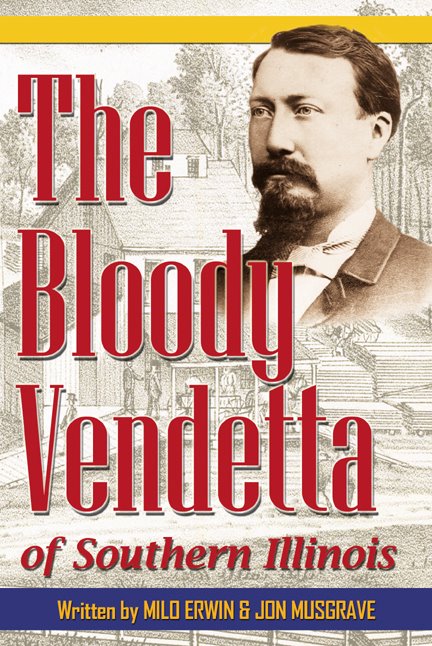
This morning between the hours of midnight and 4:30 a.m. I finally was able to make some progress on wrapping up my latest book, The Bloody Vendetta of Southern Illinois.

I'm still a couple of chapters away from completion.

This was supposed to have gone to the printers earlier this month, but a drunk drver changed my plans.

Between the pain medication that's prevented me from concentrating to the one-handed typing, it's been diffiucult to get back in the mode of writing.

I'm still shooting for the book to be available by early to mid-December in time for Christmas.

From the back cover:

In the 1870s the Bloody Vendetta wreaked havoc in the heart of Southern Illinois leaving a half dozen men assassinated and property values in freefall. As a defense attorney Milo Erwin represented many of the suspects involved. Following the trials of 1875 and 1876, Erwin published the first detailed account of
the Vendetta. Now Jon Musgrave pieces together the rest of the story, combining Erwin's work with contemporary newspaper accounts as well as modern research. From the rise and fall of the Ku Klux Klan as they took advantage of the chaos, to the
events of what happened after Erwin wrote his book, Musgrave connects the dots from the Vendetta to the Civil War era Aiken Gang to the second generation of outlaws including the ill-famed Jennings Gang of the Wild West and later Hollywood, to the
robberies and murder in the Carterville and Carbondale area of the mid 1890s.

The book will be a 6" x 9" paperback, at least 224 pages and will retail for $14.95. (ISBN: 0-9707984-6-6)

Saturday, November 19, 2005

Illinoize Gearing Up for Illinois Politics

Rich Miller with Capitol Fax is starting a new group blog on Illinois politics and has asked yours truly to participate.

Go, check it out. It's at capitalfax.blogspot.com.

Wild Things

Watch your back boys. them Texas roadkill critters are on the way to Egypt.

The Daily Egyptian is reporting thatb armadillo sightings are on the rise herer in Southern Illinois.

Armadillos provide several services. They eat insects, help till soil, and in a pinch, they can make a tasty meal.

Hitching rides in railroad cars and barges up from the south, armadillos have begun to migrate to southern Illinois. The armored animals, often the victims of collisions with vehicles, were originally native to Central America, but in the 1800s, they appeared in the United States, according to Joyce Hufmann, a research scientist for the Illinois National History Survey.

Clay Nielsen, wildlife ecologist for the Cooperative Wildlife Research Lab at SIUC, said although it's too early to find out if these creatures are here for good, there is nothing to worry about.

Friday, November 18, 2005

SIU Tabs Poshard to Helm System

Congratulations go out to former U.S. Representative Glenn Poshard whom the SIU Board of Trustees announced this morning as the new president of the SIU system.

Congrats also go out to the trustees for not dragging the selection process out any longer than necessary. We all knew Poshard was the favorite.

There's a better picture of Poshard than the one above. The Marion Daily Republican has it here. It shows him ready to roll.

Confluence Gains New Work of Art?


At the risk of sounding like some old over-medicated fuddy-duddy, will someone explain to me the purpose of the stainless steel thingy unveiled Wednesday at Cairo.

This is art?

This is supposed to honor Lewis and Clark?

According to the article in today's Southern Illinoisan the 30 or so people present gave it "high marks". Really.

Please, I want to know what the locals really thought. Cairo is home to some real pieces of public art that have withstood decades of weather and still stand as a monument to the craftsmanship exerted in their creations.

Please America, stop foisting second-rate modern art onto historic sites and memorials.

Monday, November 14, 2005

L & C Sculpture Dedication Wednesdasy

CARBONDALE, Ill. -- Southern Illinois University Carbondale officials and Cairo-area citizens will gather at the confluence of the Mississippi and Ohio rivers this week to celebrate discoveries old and new.

Dedication ceremonies are set for 10 a.m. on Wednesday, Nov. 16, for the Lewis & Clark Memorial Sculpture, installed in August at the confluence of the two mighty rivers in Fort Defiance State Park.

A reception will immediately follow the dedication at approximately 10:45 a.m. at the Cairo Custom House Museum, site of a Lewis & Clark exhibit. The public is welcome at both events.

Sunday, November 13, 2005

Peoria Plans Big Museum Push

The Associated Press has a good piece today on Peoria's grand plans for a new museum.

By decade's end, one stop in downtown Peoria could land you at the controls of a giant Caterpillar Inc. earth-moving machine, behind the plate calling strikes at a high school baseball game or on a time-bending walk along the Illinois River dating back to the ice age.

All those could be part of an eclectic mix of historic, hands-on and high-tech fixtures at a proposed $100 million museum complex near the river's edge in this central Illinois city.

There's a reason better than just civic pride behind the idea.

Museum and tourism officials predict a hefty tourism payback - about $14 million a year - as they scurry to raise money that would put the facility on track to open in 2009...

Officials estimate 350,000 visitors a year would flock to Peoria-based Caterpillar's first worldwide visitor center, the first Illinois High School Association museum and hall of fame and new facilities for Peoria's Lakeview Museum and African American Hall of Fame.

What's driving the plan is this:

Culture has been a catalyst for cities from Denver to Tampa as U.S. museum visits surged from 486 million in 1989 to about 860 million today, pumping about $220 billion into the nation's economy annually, said Ed Able, president and CEO of the American Association of Museums.

The popularity rise parallels a shift over the last two decades from stodgy, static displays at museums to high-tech and hands-on exhibits that have made such facilities "intellectually accessible," Able said.

Here's a link to a synopsis of the plan. The headline above links to the main story.

Friday, November 11, 2005

White Wants Vets to Tell Their Stories


Illinois' top librarian and archivist is launching a new program to get veterans to record their war stories for future generations, as reported by WBBM 780.
Some of the most interesting history is in the details.

That's the premise of Secretary of State Jesse White, who is asking veterans to take part in the Illinois Veterans' History Project.

White remembered his own paratrooper training.

"Jumpmaster said, 'Southern jumpers die more often than Northern jumpers.'

We were kind of at a loss for that, and so one of the gentlemen from the South asked, 'Sarge, could you tell me, what do you mean by the Southern jumpers die more often than the Northern jumpers?' He said, 'When you exit the aircraft, you put your feet together, your knees together, hands on your reserve, and you count one-thousand, two-thousand, three-thousand, four-thousand, then you push your risers outward to make sure your canopy is fully inflated.

"'What the Southern jumpers do, they count one thousand-one, you all. One thousand-two, you all...."

Details can be found on White's office website.

Charlie Birger's 1920s Home Torn Down

The oft-overlooked refuge of 1920s gangster Charlie Birger bit the dust last week following a planned, but still violent, confrontation with a backhoe.

The homeplace for Birger's family stood just southeast across the highway from the Route 13 Huck's convenient store on the west side of Harrisburg.

Riding past it today I noticed the empty lot, but couldn't recall what exactly had stood there. However, thanks be given to Josie Brooks of The Book Emporium, for clueing me in to what I missed. She mentioned Brian DeNeal's article about the demolition.

HARRISBURG - The house of prohibition-era gangster Charlie Birger collapsed Wednesday under the claw of Roger Angelly's track hoe.

The house, across West Poplar Street from Hucks Convenience Store, is the future site of Central Hospital for Animals, now operating on Sloan Street.

Bill White, owner of nearby White's Florist, said the house had been in the White family since the 1940s and leaks began the steady destruction the track hoe completed.

White was too young to know the Birger family when they lived there from the early 1920s until April 19, 1928, the day of Birger's hanging at Benton.

Birger's death sentence was the penalty for Birger's orchestration of the murder of West City Mayor Joe Adams. The house was the site where Birger was arrested for the final time, 6 a.m. April 29, 1927, by Franklin County Sheriff Jim Pritchard and 11 deputies, according to Curtis G. Small's book, Mean Old Jail.

According to the story the only surprise came when the backhoe uncovered a cistern no one knew was there.

BTW, DeNeal is the son of Gary DeNeal, the biographer of Charlie Birger in his book, A Knight of Another Sort.

Thursday, November 10, 2005

Illinois History Video Fair set for Nov. 30th

As part of its 26th annual Illinois History Symposium, the Illinois State Historical Society will host the 2nd Annual Illinois History Video Fair in the Carnegie Room at Lincoln Library in Springfield, 326 South Seventh Street, on November 30.

Five feature documentary films will be shown throughout the day beginning at 9:30 a.m. The Illinois History Video Fair is free and open to the public. Teachers, students, seniors, and school groups are welcome to attend.

The Video Fair includes the premiere of The Sangamon River: A Sense of Place, at 7 p.m. This 54-minute program, produced by the University of Illinois at Springfield’s Television Office, examines the people, ecology, history, and economy of the Sangamon River Valley. Filming for The Sangamon River began in January 1994, and features many residents of Sangamon, Menard, and Macon counties.

Documentaries include:
  • Expo — Magic of the White City: The Chicago World’s Fair of 1893 (12:30 and 4:30 p.m.) is a 2-hour film narrated by Gene Wilder that explores the 400th anniversary celebration of Columbus’ discovery of America. Features hundreds of archival photographs and dramatic reenactments.

  • Artifacts & Heavy Timber: The Reconstruction of Fort Massac (9:30 a.m. and 2:30 p.m.) is a one-hour documentary that explores the $4.7 million, three-year rebuilding of the frontier military fort in Metropolis, Illinois, which was completed in 2003. Included in the film are historical works of archaeologist Paul Maynard, whose 84-year-old findings provided a blueprint for the historically accurate replica. Springfield archaeologist and preservationist Floyd Mansberger, who worked on the project, is featured.

  • The Macomb Story (10:30 a.m. and 3:30 p.m.) is a re-mastered and updated video version of a film of the same name, produced in 1984. This pictorial history about Macomb, Illinois, includes older material from the first film and picks up where it left off by focusing on Macomb’s growth and development since the film was first produced.

  • Prairie Tides: The Building of the Illinois and Michigan Canal (11:30 a.m.) chronicles the construction of the Illinois and Michigan Canal, and its impact on Illinois as a frontier state. The film documents how the canal helped transform Illinois into a state of commerce and industry.

  • The Sangamon River: A Sense of Place (7 p.m.) profiles the ecological, economic and cultural history of the Sangamon River, and features interviews with commercial fishermen, farmers, environmentalists, poets, and merchants who’ve made the river valley their home. Charles Schweighauser, the producer of the film, will introduce the program and lead a discussion afterwards.
For more information about the Illinois History Video Fair, the Illinois History Symposium, or the Illinois State Historical Society, call (217) 525-2781, or visit the Society’s website at www.historyillinois.org.

Wednesday, November 09, 2005

First Responses

The pre-orders for the revised and expanded hardcover edition of Slaves, Salt, Sex & Mr. Crenshaw went out last week. So far I'm getting positive responses.

... received your hard cover copy of "Slaves, Salt, Sex & Mr. Crenshaw" today. Thanks. I shall read it in awe of the things that was going on in my part of the country.
— Paul C.

Got the books Jon, and they are great! Thanks a lot for doing all the work on these. I'm sure you enjoyed most all of it.
Take care, Eric W.
Jon, I received the books today. The Hardcopy is very nice. It was worth the wait.
— Larry D.

A Drunk, A Shovel, My Elbow — Ouch!

Got hit by a drunk driver Friday night wielding a shovel.

Only got out of the hospital last night. Can't use my left hand.

Blogging updates will be slow, but book orders are still going out.

Thursday, November 03, 2005

HeritageFest set for this weekend

Southeastern Illinois College is hosting its 28th Annual Heritage Festival this weekend at their location a few miles east of Harrisburg.

I'll be there both days with my books. Come by and buy one or two (or maybe one for everybody on your Christmas list). Autographed books make great presents.

You can also order online here

Expert Volunteers Redo David Davis Ceiling


There are at least a few people in IHPA willing to look outside the box for solutions when the budget is tight.

Way to go to those who volunteered!

From an IHPA news release ...

BLOOMINGTON, IL – What do you do when the ceiling falls in, and the repair bill will put your budget through the roof? If it’s the 102-year-old painted canvas ceiling at the David Davis Mansion State Historic Site in Bloomington, you let the experts fix it – for free.

“We are overwhelmed by the response from the Bloomington-Normal skilled labor and business community,” said Robert Coomer, director of the Illinois Historic Preservation Agency, which administers the Davis Mansion. “A mere expression of thanks doesn’t seem enough.”

The saga began July 21, in the middle of the hottest summer in recent memory, at the 1872 vintage David Davis Mansion, one of Bloomington’s most popular historic tourist attractions. A malfunctioning air conditioning unit in the second floor of the Victorian mansion spilled twenty gallons of water that seeped through the floor and saturated the ceiling of the formal parlor below. An original, intricately painted canvas mural adorns the ceiling.

“It couldn’t have picked a worse place to leak,” said Davis Mansion Site Manager Marcia Young. “The canvas collected all of the leaking water and then pulled away from the plaster ceiling. We were absolutely sick when we discovered this one-of-a-kind piece of art sagging water-logged in the middle of the room.”

The estimated cost to repair the ceiling was $30,000. The work requires special knowledge and techniques that are rare and expensive. Unfortunately, the budget to fix the ceiling was in the basement; tight state finances allowed little leeway for repairs of this magnitude.

But the word got out concerning the Mansion’s predicament. Soon, craftspeople and businesses in the Bloomington-Normal area began offering to donate the skilled labor and materials to repair the ceiling. Marc Svensson, owner of the painting and wallcovering business in Bloomington that bears his name, reinstalled the canvas, prepared it for painting, and applied the solid background color that encompasses most of the canvas. Svensson is a graduate of the American School of Paperhanging Arts. Decorative artist Richard Schaad of Normal assembled the restoration team and did the fine-arts repainting of the floral art work in the mural. Mel Wollenschlager, master plasterer from Bloomington, removed and re-plastered the mildewed areas of the plaster substrate. John Svensson, Marc’s brother, and Michael Henning, decorative artist from Normal, assisted with the canvas reinstallation.

Experts from across the country in wallpaper hanging, historic adhesives and other technical crafts, inspired by the local labor and materials donations, offered to provide free advice and guidance so the project would follow approved historic preservation and conservation methods. Mansion officials even received assistance from the man who installs period wallpapers at the White House. “The result is more than just a repair,” said Young. “It’s the accurate and appropriate restoration of a one-of-a-kind, hand-painted piece of art.”

The donated labor and materials did not stop at the ceiling. Associated Constructors of Bloomington donated the painters’ scaffolding and Don Smith Paint and Wallpaper of Bloomington donated the metal bracing system. In addition, employees of a local corporation have donated their personal time to survey the Mansion’s climate control systems and make recommendations for retrofitting and maintenance to prevent leaks from happening in the future. Plumbers and Pipefitters Union Local 99 is donating the services of skilled craftsmen to repair the moisture-soaked insulation and leaking valves that partly contributed to the problem.

The Davis Mansion canvas, made of hemp and covered with six layers of paint, is a 1903 post-fire replacement of the original 1872 ceiling, a decorative mural painted directly on plaster by St. Louis artist August Becker. Becker’s original artwork can still be seen on the other plaster ceilings of the mansion’s first floor. The 1903 replacement is a 400-square-foot canvas that was glued to the ceiling and then painted in place by a Bloomington painting contractor, C. E. Russell. The decorative design consists of a border of multi-colored stripes with corner floral motifs.

The David Davis Mansion State Historic Site is located at 1000 E. Monroe in Bloomington, and is open Wednesday through Sunday from 9 a.m. to 4 p.m. for free public tours. It was built in 1872 for U.S. Supreme Court Justice David Davis, a close friend and associate of Abraham Lincoln, and Davis’ wife, Sarah.